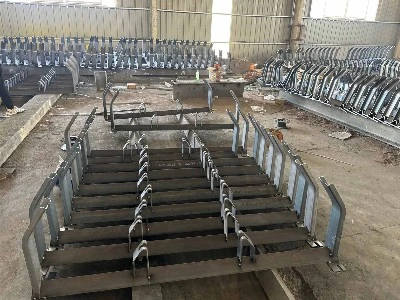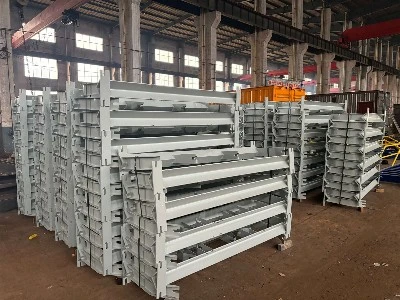
As a core load-bearing component of belt conveyors, the idler frame directly affects the operational stability, efficiency, and service life of the conveying system. Different industries and operating conditions have significantly different requirements for the structure, load-bearing capacity, and corrosion resistance of the idler frame. Customized production is key to meeting the personalized needs of our clients. Leveraging our professional technical team and mature production system, we provide clients with a full-process customized belt conveyor idler frame service. From needs assessment to finished product delivery, we precisely control every step to ensure that the product perfectly adapts to the actual operating conditions.
The first step in our customized service is in-depth needs assessment and operating condition research. At the beginning of a project, our technical team conducts multiple rounds of detailed communication with the client to comprehensively understand the core requirements: including basic parameters such as the conveyor's capacity, bandwidth, conveying angle, and idler model, as well as the specific operating conditions of the client's industry. For example, in dusty and high-humidity environments such as mines and ports, enhanced corrosion resistance is required; in high-temperature workshops, high-temperature resistant materials are needed; and for heavy-duty conveyors, improved structural load-bearing strength is required. Simultaneously, the team conducts on-site inspections of customer locations to understand installation space limitations and the connection requirements of existing conveying systems. This avoids product incompatibility due to parameter deviations, ultimately creating a detailed requirements list to lay the foundation for subsequent solution design.
Scientific solution design is the core of customized idler frames. Based on the requirements list and relevant industry standards, the technical team conducts targeted structural design and mechanical calculations. First, appropriate steel grades are selected according to load-bearing requirements, commonly using Q235B and Q355B steels to ensure material strength meets heavy-duty conveying requirements. Second, the structural form of the idler frame is optimized; for example, trough idler frames require precise control of the trough angle, self-aligning idler frames require a reasonable steering mechanism, and parallel idler frames must ensure installation flatness. During the design process, a product model is built using 3D modeling software to simulate the stress conditions under actual operating conditions, promptly optimizing weak structural links to reduce vibration and wear during operation. After the solution is completed, proactive communication and confirmation with the customer are conducted, and adjustments and iterations are made based on customer feedback until the final production drawings are formed.
Refined manufacturing is key to ensuring product quality. Upon raw material arrival, strict inspection standards are enforced, with comprehensive testing of the steel's chemical composition and mechanical properties to prevent unqualified materials from being used in production. During production, processes such as material preparation, welding, stamping, and assembly are precisely carried out according to design drawings: CNC cutting equipment is used in the material preparation stage to ensure component dimensional accuracy; welding is performed by professional technicians, using matching welding materials and multi-layer, multi-pass welding processes to avoid defects such as incomplete penetration and porosity, while stress relief treatment prevents structural deformation; assembly precision of each component is strictly controlled to ensure flexible rotation and tight fit with the belt after installation. Complete process records are maintained throughout production to ensure quality traceability.
Comprehensive quality inspection and excellent delivery services complete the customized service. After finished product completion, multi-dimensional quality inspections are conducted: visual inspection checks for welding defects and surface flatness issues; dimensional inspection verifies key parameters to ensure consistency with design drawings; load-bearing tests verify structural strength to ensure it meets actual conveying requirements; and for products operating under special conditions, additional performance tests such as corrosion resistance and high-temperature resistance are performed. After passing inspection, customized packaging and securing solutions are adopted according to product dimensions and transportation requirements to prevent deformation or damage during transportation. Simultaneously, professional technicians provide on-site installation guidance to assist customers in installing and commissioning the idler frames, and offer post-installation maintenance advice to ensure the stable and efficient operation of the conveyor system.
The core of customized conveyor idler frames lies in "precise fit," which requires professional control throughout the entire process, from demand consultation and solution design to manufacturing and quality inspection. We always prioritize customer needs, leveraging our technological advantages and production capabilities to create high-quality, customized idler frame products for customers in various industries, helping them improve the operating efficiency of their conveyor systems, reduce maintenance costs, and become a trusted supplier of conveyor equipment services.