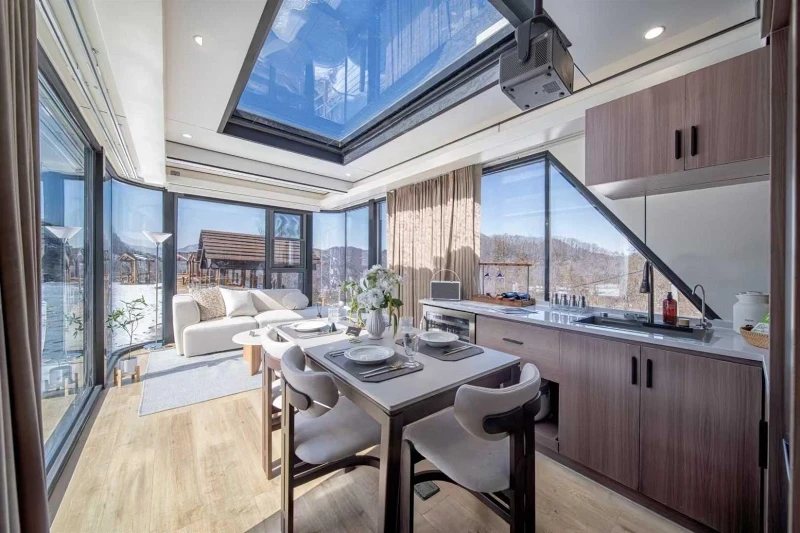
Space capsule house: A new type of living form empowered by technology, redefining new living scenarios
With the upgrading of the trend towards low-carbon and modularization in the construction industry, as well as the increasing demands for flexibility and individuality in living, space capsule houses, leveraging the triple advantages of "technology + practicality + environmental friendliness", have moved from concept to reality and gradually permeated various scenarios such as tourism accommodation, rural revitalization, and emergency support, becoming an important supplement to traditional architecture. Space capsule houses draw inspiration from aerospace technology and integrate core technologies such as modular production, lightweight materials, and intelligent control systems. They combine an elegant appearance with strong functionality, breaking the limitations of location and terrain on living, and aligning with contemporary people's pursuit of efficient, environmentally friendly, and novel living experiences. They are redefining "a mobile and comfortable home".
Core definition and design concept of space capsule houses
(1) Core definition
Space capsule houses, also known as "modular space capsule homestays" or "mobile intelligent cabins", are a new type of movable building based on standardized modules, using lightweight, high-strength, and environmentally friendly materials for prefabricated production. After transportation and assembly (or overall transportation), they can be put into use. Their appearance is inspired by the streamlined design of a space capsule, with simple and smooth lines, presenting a sealed box structure. The interior space is compact but fully functional, capable of meeting various needs such as living, working, and leisure, and featuring features such as mobility, assembly, recyclability, and easy maintenance. Unlike traditional brick-and-frame or frame structures, they do not require complex foundation construction and are suitable for various complex terrains.
(2) Core design concept
The design of space capsule houses does not merely aim for a "spacey" appearance but focuses on the four core aspects of "efficiency, environmental friendliness, flexibility, and comfort", balancing practicality and innovation. It can be further decomposed into three main concepts:
(1) Modular integration concept: Breaking away from the traditional construction model of "on-site pouring, step-by-step construction", space capsule houses adopt factory prefabrication production - breaking the house down into structural modules and functional modules (kitchen, bathroom, water and electricity, soft furnishings, etc.), completing precise processing, assembly, and debugging in the factory, and then transporting it as a whole to the site, requiring only simple fixation for use. The modular design not only shortens the construction period (a single capsule from production to use only takes 7-15 days, far shorter than the 3-month period of traditional buildings) but also enables flexible combination of modules, allowing for the expansion of space as needed (such as a single capsule can be combined into a double capsule or multiple capsules, suitable for different scenarios such as family living and homestay clusters).
(2) Lightweight and high-strength balance concept: To meet the requirements of mobility and risk resistance, space capsule houses balance "lightweight" and "high strength" in material selection - the main structure often uses aluminum alloy and steel structures (such as galvanized square steel, stainless steel frames), which have low density and light weight (a single capsule weighs typically between 5-15 tons, and can be transported by a regular truck). At the same time, they have excellent compressive, wind-resistant, and seismic resistance performance (wind resistance level can reach 12-15, seismic resistance level 6-8), suitable for complex terrains such as mountains, beaches, and grasslands, and capable of withstanding adverse weather conditions such as heavy rain, snowstorms, and strong winds to ensure living safety.
(3) Low-carbon, environmental friendliness, and intelligent adaptation concept: On the one hand, the prefabrication production mode reduces dust, noise, and construction waste generated during on-site construction (reducing construction waste by 80% compared to traditional buildings), and the main materials (aluminum alloy, steel structure) have a recycling rate of over 90%, aligning with the low-carbon trend in the construction industry under the "dual carbon" policy. On the other hand, integrating intelligent control systems, they adapt to different environmental needs - such as installing photovoltaic panels + energy storage batteries in hot regions to achieve self-sufficiency of clean energy; installing break-through aluminum windows + polyurethane insulation layers in cold regions to improve insulation and heat preservation effects; The interior is equipped with an intelligent home appliance linkage system, allowing for remote control of lighting, air conditioning, curtains, etc., achieving both energy conservation and comfort.