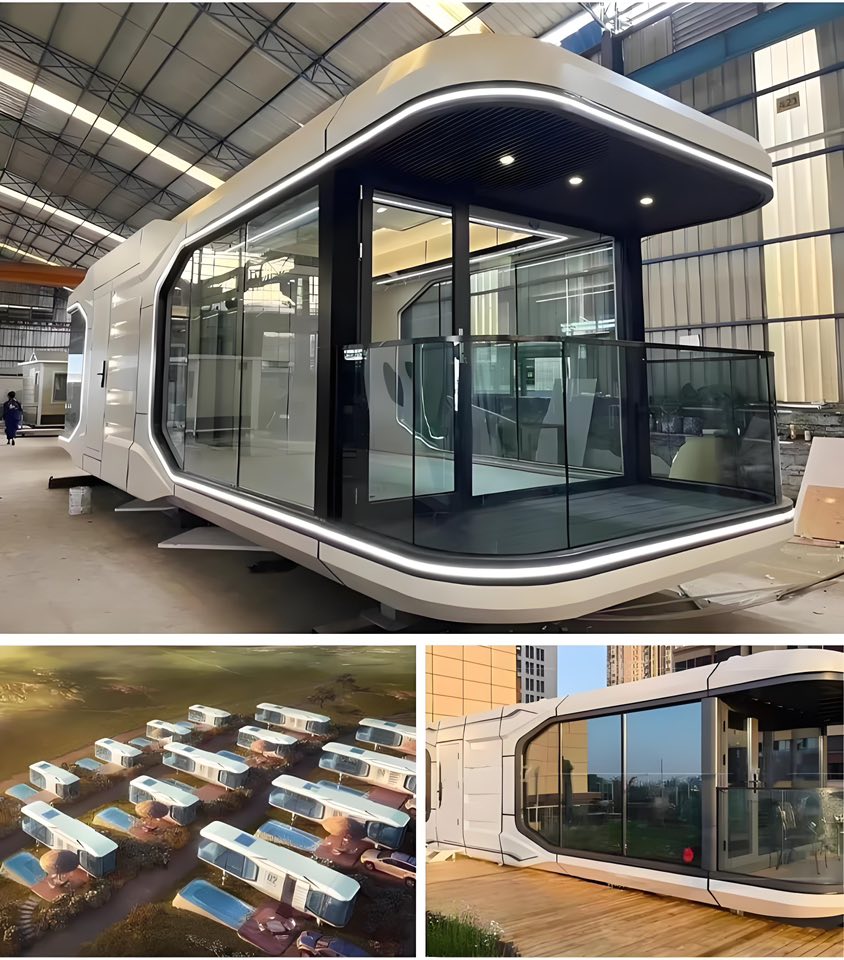
Compared with traditional buildings such as brick-concrete and frame structures, space cabin houses have significant advantages in construction period, adaptability to various scenarios, environmental performance, and usage flexibility. At the same time, they make up for the shortcomings of traditional mobile buildings such as RVs and container houses. The specific advantages can be clearly presented through comparison and analysis:
Core advantages:
1. Short construction period and high implementation efficiency: Traditional buildings need to go through processes such as foundation excavation, main structure pouring, and decoration, with a construction period usually ranging from 3 to 6 months, greatly affected by weather and construction teams. Space cabin houses are factory prefabricated (7-10 days for single cabin production), and only require 1-3 days for installation and commissioning on site, with an overall period of 7-15 days. They are not affected by weather and can achieve "production and transportation immediately, installation and use immediately", significantly reducing time costs. They are particularly suitable for the rapid implementation of cultural tourism projects and emergency support scenarios.
2. No need for complex foundations, adaptable to various terrains: Traditional buildings have high requirements for foundations, needing to level the land and pour concrete foundations, and can only be adapted to flatlands and gentle slopes. Construction in mountainous areas, by the sea, on grasslands, and other complex terrains is difficult and costly. Space cabin houses only require simple ground hardening (or laying steel structure supports), without the need for deep foundation excavation, and can be adapted to various terrains such as mountains, cliffs, by the sea, by lakes, and on grasslands. They can even be built on rooftops and terraces, breaking the geographical restrictions on living and expanding the boundaries of living scenarios.
3. Mobile and reusable, highly flexible: Traditional buildings are fixed structures and cannot be moved after construction. If the site planning changes, they can only be demolished, resulting in severe waste of resources. Space cabin houses are lightweight and can be transported as a whole by trucks, achieving "use in one place and move to multiple places", and there is no loss after relocation, allowing for repeated use (such as for the iteration of cultural tourism projects or the relocation of rural homestays). They also support module assembly, with a single cabin expandable to double or multiple cabins, allowing for adjustment of space size according to needs, and are suitable for diverse demands such as family living, homestay clusters, and office spaces. Their usage flexibility far exceeds that of traditional buildings.
4. Low carbon and environmentally friendly, with lower energy consumption: Traditional buildings generate a large amount of dust, noise, and construction waste during on-site construction, with a material waste rate of over 15%. Moreover, brick-concrete structures have poor insulation and heat insulation performance, resulting in high energy consumption during later living. Space cabin houses are factory prefabricated, reducing construction waste by over 80%, and the main materials (aluminum alloy, steel structure) have a recyclability rate of over 90%, aligning with the concept of low carbon. Additionally, the intermediate protective layer uses highly efficient insulation and heat insulation materials, combined with an intelligent control system, eliminating the need for excessive heating in winter and excessive cooling in summer. Energy consumption is reduced by 40% to 60% compared to traditional buildings, resulting in lower long-term usage costs.
5. High aesthetic level and strong sense of technology, adaptable to personalized needs: Traditional buildings have a single appearance style, mostly brick-concrete and tile decoration, and are difficult to meet the personalized aesthetic needs of contemporary people. Space cabin houses have a streamlined design on the exterior, with metallic texture exterior panels, giving a strong sense of technology and futurism. The colors and textures can be customized (such as wood grain, stone texture, solid colors, etc.), adapting to the aesthetic needs of different scenarios such as cultural tourism, rural areas, and cities. The interior integrates an intelligent control system, allowing for remote control of lighting, air conditioning, curtains, and household appliances. Some high-end models are equipped with photovoltaic energy storage systems, fresh air systems, and intelligent security systems (cameras, infrared alarms, smoke detectors), combining technological experience with living safety, and meeting the pursuit of young people for new living forms.
6. Earthquake and wind resistant, with excellent safety performance: Traditional brick-concrete structures have poor earthquake and wind resistance, with an earthquake resistance grade of 4-5 and a wind resistance grade of 8-10. They are prone to damage in the face of earthquakes and strong winds. Space cabin houses have excellent earthquake and wind resistance, with a safety performance far superior to traditional buildings. The main body of the space cabin house is made of high-strength steel structure / aluminum alloy frame, with a stable structure. It can withstand earthquakes of magnitude 6 to 8 and winds of 12 to 15 levels, capable of resisting strong typhoons, moderate to strong earthquakes, heavy snow and other severe weather conditions. Meanwhile, its sealed structure can prevent rain leakage and sand invasion. Its safety performance far exceeds that of traditional buildings, making it particularly suitable for areas prone to natural disasters such as coastal areas and mountainous regions.