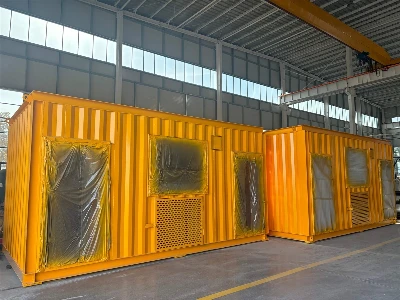
In today's rapidly developing industrial automation and intelligent manufacturing landscape, electrical control systems, as the "nerve center" of the production process, have their stability, safety, and flexibility directly determining the operating efficiency of the entire production line. Electrical control equipment container houses are an innovative solution designed to meet this need. Using standard shipping containers as the basic structure, they integrate core components such as control cabinets, PLC systems, monitoring equipment, and UPS power supplies through professional structural modifications, sound and heat insulation treatment, and intelligent wiring design, creating a modular control space that is mobile, sealed, and highly functional. This new type of facility breaks the limitations of traditional fixed electrical control rooms and plays an irreplaceable role in many fields, including power engineering, chemical parks, mining, and emergency rescue, becoming a flexible and efficient "mobile control center" in industrial settings.
The core advantage of electrical control equipment container houses lies in their "modular integration + high adaptability" design concept, which fundamentally solves many pain points of traditional electrical control room construction. Traditional electrical control rooms often require lengthy processes including site selection, foundation laying, main structure construction, and pipeline installation, resulting in construction periods of several months. They are also subject to strict limitations of site geology and climate conditions, and once built, cannot be relocated, making it difficult to adapt to production line adjustments or the phased needs of projects. In contrast, electrical control equipment container houses use standardized containers as the base, allowing all structural modifications and interior decoration to be completed in the factory, including reinforcement of the load-bearing frame, installation of anti-static flooring, and installation of ventilation and cooling systems. After factory completion, they are directly transported to the site and can be quickly put into use through hoisting and positioning. The cycle from order confirmation to official operation can be shortened to 15-30 days, greatly improving project efficiency. For temporary construction projects or emergency repair scenarios, this "ready-to-use" feature saves companies significant time and reduces losses caused by production interruptions.
Structural safety and environmental adaptability are the core competencies of electrical control equipment container houses, and their design and manufacturing process always revolves around the core goal of "ensuring stable equipment operation." In terms of structural strength, the container itself is welded from high-strength steel, with a wind resistance rating of level 10 or higher, and its compressive load-bearing capacity meets the installation requirements of various electrical control equipment. To address the sensitivity of electrical control equipment to vibration, shock-absorbing rubber pads are installed at the bottom of the container to reduce the impact of vibration on precision instruments during transportation and use. For internal environment control, the facility is equipped with an intelligent constant temperature and humidity system. Through the联动 (interconnection) of industrial air conditioning and fresh air systems, the indoor temperature is stabilized within the optimal range of 18-25℃, and the humidity is controlled between 40%-60%, preventing equipment short circuits or performance degradation caused by high temperature and high humidity environments. At the same time, the container uses double-layer rock wool sandwich panels for sound insulation and heat insulation. The outer steel plate resists wind and rain erosion, while the inner rock wool effectively blocks external noise and extreme temperatures. The interior is also coated with anti-static and anti-corrosion paint, combined with excellent sealing door and window designs, forming a dustproof, waterproof, and electromagnetic interference-proof sealed space, providing all-weather safety protection for electrical control equipment.
The intelligent and user-friendly internal layout design further enhances the practical value of the electrical control equipment container house. In terms of wiring systems, the container reserves dedicated strong and weak current cable trays and conduit channels, using standardized top or bottom wiring designs to strictly separate power lines and signal lines, avoiding electromagnetic interference and facilitating future maintenance and upgrades; emergency lighting and safety exit indicator lights are installed on the top, along with fire safety facilities such as smoke detectors and fire extinguishers, comprehensively ensuring the personal safety of maintenance personnel. Some high-end customized models are also equipped with intelligent monitoring systems, which use cameras and sensors to monitor indoor temperature and humidity, equipment operating status, and personnel entry and exit in real time. The data is synchronized to the background management platform, enabling remote visual operation and maintenance. In addition, sufficient operating space and maintenance channels are reserved inside the container, and the control panel adopts ergonomic design, facilitating daily monitoring and equipment debugging by maintenance personnel, demonstrating a deep adaptation to the usage scenarios in every detail.
From an application perspective, the adaptability of electrical control equipment container houses covers almost all industrial fields. In the power industry, it can serve as a control unit for outdoor substations, reaching remote areas or temporary construction sites and solving the challenges of building traditional control rooms; in chemical parks, its customized features such as corrosion resistance and explosion protection (some models meet explosion-proof requirements) make it suitable for harsh environments with flammable and explosive materials, ensuring the safe operation of production control systems; in mining and infrastructure projects, its mobility perfectly matches the needs of temporary production lines, allowing for easy relocation to new sites after project completion, thus avoiding resource waste; in emergency response situations, such as providing temporary power supply after earthquakes or floods, it can quickly establish a temporary electrical control center to support the stable operation of rescue equipment. Even in the new energy sector, it has become a core control platform for photovoltaic power plants and energy storage projects, contributing to the efficient utilization of clean energy.